
Affordable CPR & First Aid Courses In Adelaide

Table of Contents
Key Takeaways
- Every Australian workplace must have at least one first aid kit that all workers can reach quickly, including in work vehicles when workers travel (Safe Work Australia).
- The standard kit covers cuts, sprains, minor burns, major bleeding, broken bones, eye injuries and shock. Sprains and strains alone are 36.6% of serious workplace injury claims (Key WHS Statistics 2026).
- What else goes in depends on your hazards. Heat exposure ranges from 33.0% of hospitality workers to 64.3% of mining workers, and that should shape your kit (Australian Worker Exposure Survey 2026).
A first aid kit bought off the shelf is a starting point, not an answer. Safe Work Australia’s guidance says the contents should come from a risk assessment of your own workplace. Here is what the standard workplace first aid kit covers, and what the 2026 injury and exposure data says to add for your industry.
What the Law Requires
Safe Work Australia says you must have at least one first aid kit in your workplace. It should be:
- in a place all workers can see and reach quickly
- near areas where injury or illness is more likely
- inside work vehicles if workers travel for their job
Consider more than one kit if your workplace is spread out, and maintain and check kits regularly.
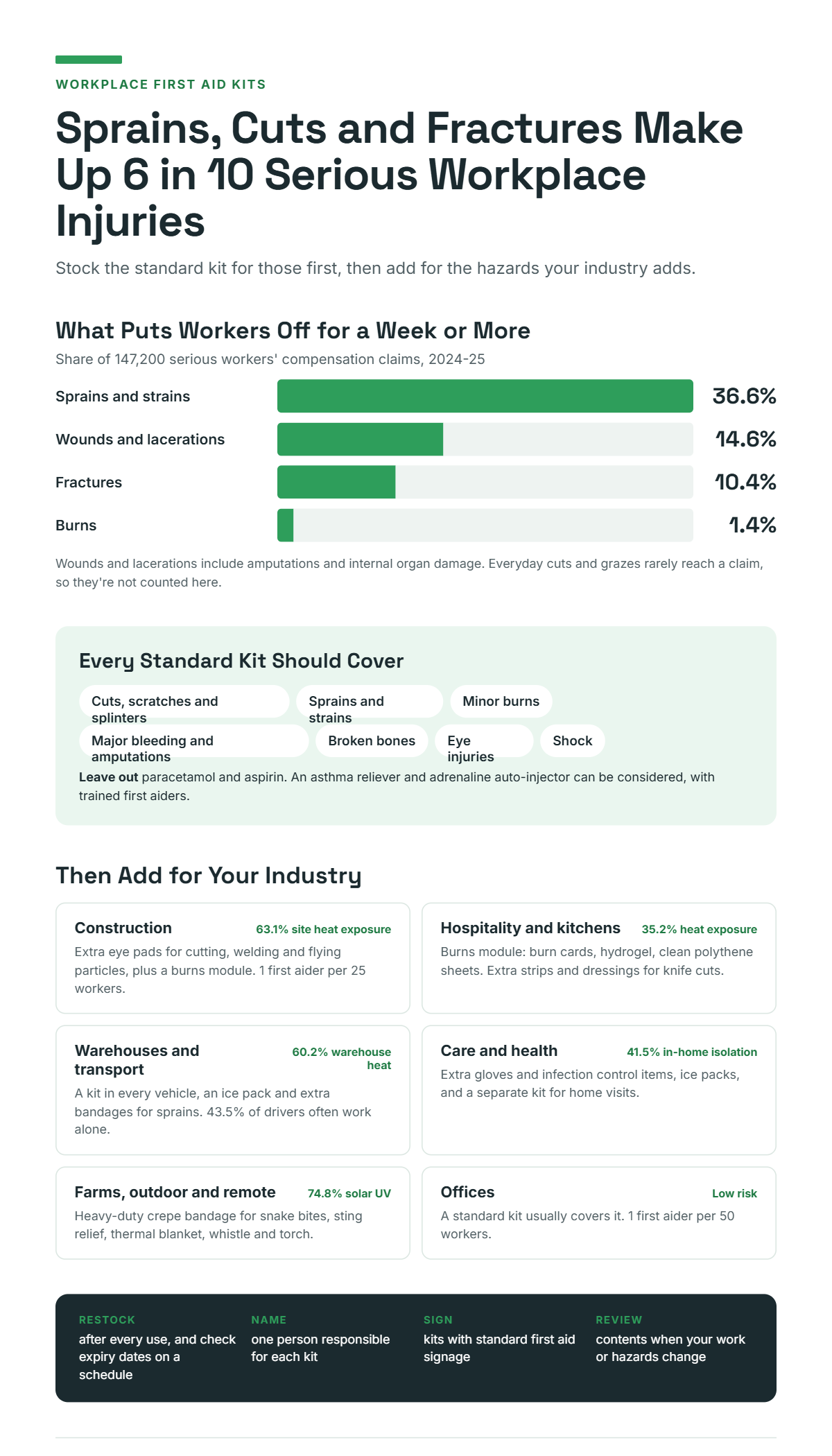
The Standard Workplace First Aid Kit Checklist
Safe Work Australia’s Model Code of Practice: First aid in the workplace says a kit should cover cuts, scratches, punctures and splinters; muscular sprains and strains; minor burns; amputations and major bleeding; broken bones; eye injuries; and shock. Its Appendix E lists example contents. In summary, a standard kit includes:
- CPR and infection control: a CPR instruction chart, a resuscitation face mask or shield, and disposable nitrile gloves
- Wound care: sterile gauze, saline, wound cleaning wipes, adhesive strips and non-adherent dressings in several sizes
- Bleeding and support: conforming and crepe bandages, triangular bandages, wound dressings and combine pads
- Tools: scissors, tweezers, single-use splinter probes, safety pins and tape
- Other: eye pads, an emergency blanket, an instant ice pack, a notebook and pen, clip-seal bags, and access to clean running water or hydrogel for burns
Check the Code’s Appendix E for the full list and quantities.
The Code advises against putting medications such as paracetamol and aspirin in a kit. Workplaces may consider an asthma reliever with a spacer and an adrenaline auto-injector, stored correctly and with trained first aiders.
Why These Items: What Australian Workers Actually Get Hurt By
The 2026 claims data lines up closely with the kit. Of 147,200 serious claims in 2024-25:
- traumatic joint, ligament, muscle and tendon injuries (sprains and strains): 36.6%
- wounds, lacerations, amputations and internal organ damage: 14.6%
- fractures: 10.4%
- burns: 1.4%
These count only injuries serious enough for a week or more off work. The everyday cuts and grazes a kit deals with mostly never reach a claim.
What to Add for Your Industry
Construction
Construction workers carry more hazards at once than any other industry: 68.2% probably have five or more hazard exposures, against 22.2% of all workers (Australian Worker Exposure Survey 2026). Heat affects 63.1% of people working on construction sites and solar UV 67.5% of construction workers. The Code suggests extra eye pads where cutting, welding or flying particles are involved, and a burns module where workers face burns. Construction is a high-risk workplace under the Code, which recommends one first aider for every 25 workers.
Hospitality, Cafés and Kitchens
Heat affects 35.2% of people working in restaurants, kitchens and cafés. Add the Code’s burns module: burn instruction cards (one in the kit, one by the water supply), hydrogel sachets and dressings, clean polythene sheets and a conforming bandage. Keep extra adhesive strips and dressings for knife cuts.
Warehouses, Transport and Delivery
Heat affects 60.2% of people who work in warehouses. Road and rail drivers are among the most likely to work alone, at 43.5% often or all the time. Put a kit in every vehicle, add an ice pack and extra bandages for manual handling sprains, and make sure drivers know how to use what they carry.
Aged Care, Disability Support and Health Care
The leading cause of serious claims across occupations is body stressing (35.2%), and care work involves handling people. Stock extra gloves and infection control items, ice packs, and a kit for home visits, where 41.5% of people working in another person’s home report difficulty getting help, discomfort or working alone.
Farms, Outdoor and Remote Work
Solar UV affects 74.8% of agriculture workers. The Code’s outdoor module adds a heavy-duty crepe bandage for snake bites and sting relief; its remote module adds sheeting for burns, a thermal blanket, a whistle and a torch. See our first aid guides for spider bites, redback bites and bull ant bites.
Offices and Low-Risk Workplaces
A standard kit usually covers an office. The Code recommends one first aider for every 50 workers in low-risk workplaces.
Keeping Your Kit Ready
- Restock after every use and check contents and expiry dates on a regular schedule.
- Name a person responsible for each kit.
- Make kits easy to find with standard first aid signage.
- Review contents when your work or hazards change.
A Kit Is Only as Good as the Person Using It
A well-stocked kit does little if nobody knows how to use it under pressure. Our Provide First Aid certification course and CPR certification course cover the skills behind every item in the kit. For a home or personal kit, see our DIY first aid kit guide.
Frequently Asked Questions
What Must Be in a Workplace First Aid Kit in Australia?
There is no single fixed list in law. Safe Work Australia’s model Code says a kit should cover cuts, sprains and strains, minor burns, major bleeding, broken bones, eye injuries and shock, and gives example contents in Appendix E. Your risk assessment decides what else to add.
Is a Workplace First Aid Kit a Legal Requirement?
Yes. Safe Work Australia says every workplace must have at least one first aid kit that workers can access, including on night shifts and when working away from the usual workplace.
How Many First Aid Kits Does a Workplace Need?
At least one. Add more if the workplace is spread out, has several floors or separate work areas, or if workers travel, so a kit is always close by.
Do Work Vehicles Need a First Aid Kit?
Safe Work Australia says first aid kits should be kept inside work vehicles if workers travel for their job.
Can You Keep Paracetamol in a Work First Aid Kit?
The model Code advises against medications such as paracetamol and aspirin because of possible side effects and drug laws. It says workplaces may consider an asthma reliever and an adrenaline auto-injector with trained first aiders.
How Often Should a First Aid Kit Be Checked?
Safe Work Australia says kits should be maintained and checked regularly but doesn’t set a national frequency. Restock after every use and set a regular check in your first aid procedures.
Sources
- Safe Work Australia, First aid. https://www.safeworkaustralia.gov.au/safety-topic/managing-health-and-safety/first-aid
- Safe Work Australia, Model Code of Practice: First aid in the workplace (July 2019), Appendix E. https://www.safeworkaustralia.gov.au/doc/model-code-practice-first-aid-workplace
- Safe Work Australia, Key Work Health and Safety Statistics Australia 2026, released 12 October 2026. https://data.safeworkaustralia.gov.au/reports/key-whs-statistics-australia/latest-release
- Safe Work Australia, 2026 Australian Worker Exposure Survey: Analytical Report (September 2026). https://data.safeworkaustralia.gov.au/datasets/australian-worker-exposure-survey


