
What Does a Support Worker Do? Duties, Skills and Staying Safe on the Job

Table of Contents
Key Takeaways
- Support workers help people with disability, older people and others to live as independently as possible: personal care, daily tasks, community access and companionship.
- It’s a large, growing workforce. Safe Work Australia counts more than 657,000 people in the nursing, care and support workforce.
- The most common workplace injuries in care work come from moving and assisting people. Manual handling training, the right equipment and good habits prevent most of them.
Support work is one of the most rewarding entry points into the care sector. You help someone get through their day on their own terms, and you can start with a short course. If you’re thinking about it, here is what the job involves, the rules you’ll work under, and what Safe Work Australia’s data says about staying safe and well in the role.
What Does a Support Worker Do?
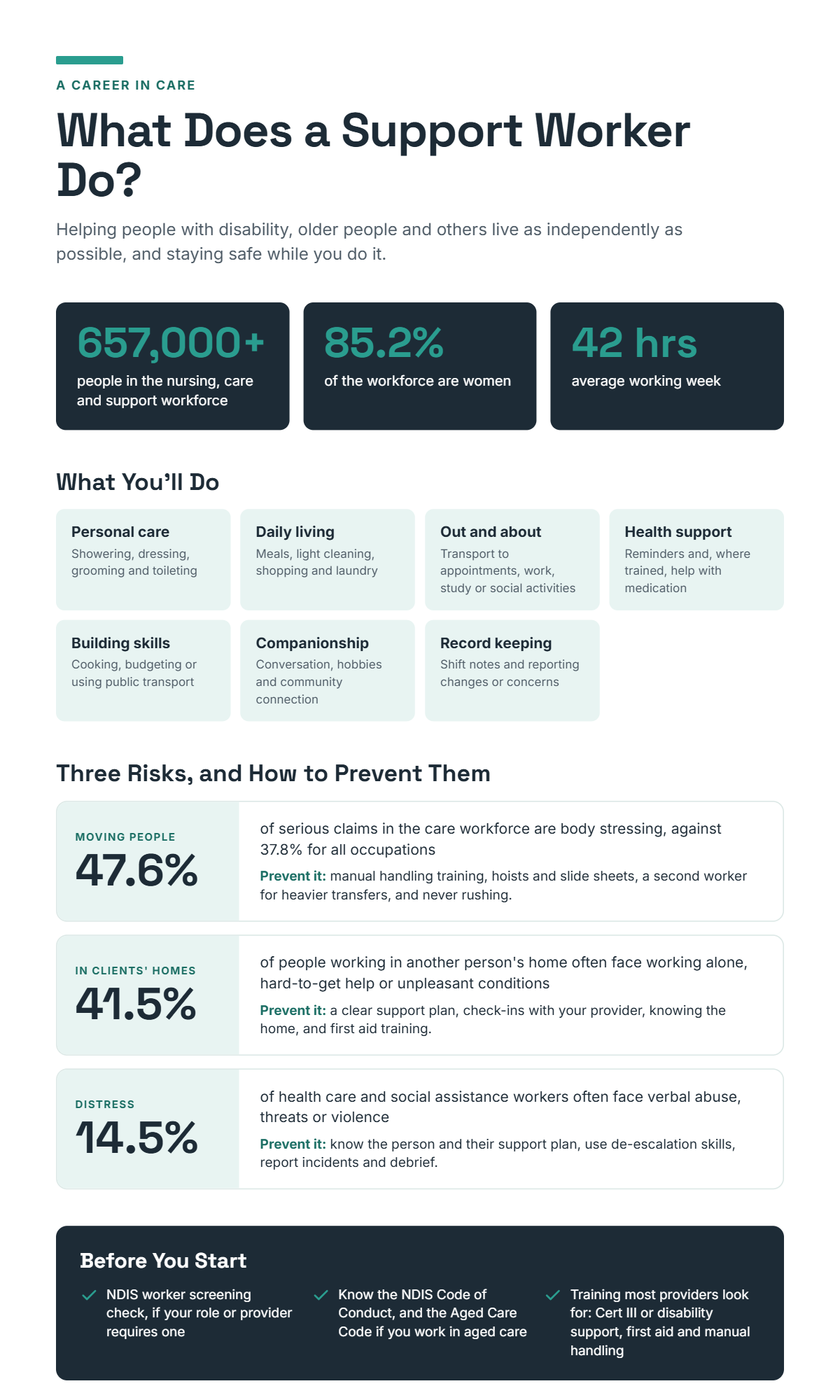
A support worker helps a person with the things they need or want to do in daily life. The mix depends on the person you support, but typical support worker duties include:
- Personal care: help with showering, dressing, grooming and toileting
- Daily living: meal preparation, light cleaning, shopping and laundry
- Getting out and about: transport to appointments, work, study or social activities
- Health support: reminders and, where trained and authorised, help with medication
- Building skills: supporting someone to learn or keep skills such as cooking, budgeting or using public transport
- Companionship: conversation, hobbies and community connection
- Record keeping: writing shift notes and reporting changes or concerns
Where Do Support Workers Work?
Support workers work in people’s homes, shared supported accommodation, day programs and out in the community. Many work with NDIS participants, but the same skills transfer to aged care and community care. Work can be full-time, part-time or casual, with shifts across days, evenings and weekends.
Skills That Make a Good Support Worker
- patience, respect and good listening
- clear communication, including with people who communicate differently
- reliability and good judgement when working without a supervisor nearby
- practical skills: safe manual handling, first aid, infection control and, in many roles, medication assistance
The Care Workforce at a Glance
Safe Work Australia’s profile of the nursing, care and support workforce (May 2025), which includes aged and disabled carers, describes a large and diverse workforce:
- more than 657,000 workers (2021 Census)
- 85.2% women
- 33% from a non-English-speaking background, against 22.6% across all occupations
- an average of 42 hours a week
Jobs and Skills Australia’s Occupation Shortage List shows ongoing shortages across these occupations, which is why trained support workers are in demand.
Common Workplace Risks, and How Support Workers Avoid Them
Every job has risks. In support work they are well understood, which means they can be planned for. Here is what Safe Work Australia’s data shows, and what prevents each one.
Moving and Assisting People
The most common cause of serious injury claims in the care workforce is body stressing: the strain of lifting, moving and handling. It made up an average of 47.6% of the workforce’s serious claims over a decade, compared with 37.8% for all occupations, and in over half of those claims another person was directly involved.
How it’s prevented: manual handling training, using equipment such as hoists and slide sheets, asking for a second worker for heavier transfers, and never rushing a transfer. A manual handling course teaches the techniques before you start.
Working in Someone’s Home
Much support work happens in clients’ homes, often alone. In Safe Work Australia’s 2026 Worker Exposure Survey, 41.5% of people who work in another person’s home reported at least one of: finding help hard to get, unpleasant physical conditions or working alone, often or all the time.
How it’s prevented: a clear support plan, a check-in system with your provider, knowing the home before your shift, and first aid training so you can respond while help is on the way.
Supporting People Through Distress
People sometimes show distress through their behaviour. In the 2026 survey, 14.5% of health care and social assistance workers said they faced verbal abuse, threats or violence often or all the time.
How it’s prevented: getting to know the person and their support plan, communication and de-escalation skills, following any behaviour support plan, and reporting incidents so your provider can adjust the support. Debriefing after a hard shift matters too.
Rules Every Support Worker Should Know
- NDIS worker screening check: you need one if you work for a registered NDIS provider in a risk-assessed role, or if your provider or the participant you support requires it. You apply through your state or territory’s worker screening unit.
- NDIS Code of Conduct: registered NDIS providers, their key personnel and NDIS workers must follow it. The NDIS Commission offers a free online training module that explains your obligations.
- Aged Care Code of Conduct: if you also work in aged care, you must comply with it under the Aged Care Act 2024.
- Work health and safety duties: your employer must provide training, instruction and supervision, and you must take reasonable care for your own safety and others’ and follow reasonable safety instructions.
How Training Prepares You
There’s no single compulsory qualification for every NDIS support role, but most providers look for formal training. Skills Training College offers:
- Certificate III in Individual Support
- Disability support course
- Assist clients with medication (HLTHPS006)
- Provide First Aid and manual handling
See all NDIS courses or save with a healthcare course bundle.
Frequently Asked Questions
What Does a Support Worker Do Day to Day?
It depends on the person they support. A typical day can include personal care, preparing meals, household tasks, transport to appointments or activities, help with medication where trained, and writing shift notes.
What Qualifications Do You Need to Be a Support Worker?
There is no single mandatory qualification for every NDIS support role, but most providers look for a Certificate III in Individual Support or a disability support course, plus first aid. You will usually also need an NDIS worker screening check.
Do Support Workers Need an NDIS Worker Screening Check?
Yes, if you work for a registered NDIS provider in a risk-assessed role, or if your provider or the participant you support requires one. You apply through your state or territory’s worker screening unit.
Is Support Work Physically Demanding?
It can be, mainly when helping people move. Safe Work Australia’s data shows body stressing is the most common cause of serious injury claims in care work, and manual handling training and equipment are the main ways to prevent it.
What Is the Difference Between a Disability Support Worker and an Aged Care Worker?
Both provide personal care and daily support. Disability support workers usually work with NDIS participants of any age. Aged care workers support older people through aged care services and follow the Aged Care Code of Conduct.
How Do Support Workers Stay Safe When Working in Clients' Homes?
By following the support plan, checking in with their provider, knowing the home and its risks before the shift, and having current first aid and manual handling training.
Sources
- Safe Work Australia, WHS Profile: Nursing, Care and Support Workforce (May 2025). https://data.safeworkaustralia.gov.au/profile/whs-profile-nursing-care-support-workforce
- Safe Work Australia, 2026 Australian Worker Exposure Survey: Analytical Report (September 2026). https://data.safeworkaustralia.gov.au/datasets/australian-worker-exposure-survey
- NDIS Quality and Safeguards Commission, Worker screening. https://www.ndiscommission.gov.au/workforce/worker-screening
- NDIS Quality and Safeguards Commission, NDIS Code of Conduct. https://www.ndiscommission.gov.au/rules-and-standards/ndis-code-conduct
- Aged Care Quality and Safety Commission, Workers and their responsibilities. https://www.agedcarequality.gov.au/workers/workers-and-their-responsibilities


