Kitchen Safety in Cafés and Restaurants: What New Hospitality Workers Should Know

Table of Contents
Key Takeaways
- Hospitality’s injuries are mostly everyday ones: strains from lifting, cuts, burns, slips and heat. That makes them very preventable.
- In Safe Work Australia’s 2026 survey, 35.2% of people working in restaurants, kitchens and cafés had probable heat exposure, and lifting causes about half of serious strain injuries among hospitality and retail workers.
- New workers are protected by clear rules: food handler training under Standard 3.2.2A, RSA laws for serving alcohol, and your right to safety training and to report injuries.
Hospitality is where many Australians get their first job, and a commercial kitchen teaches skills fast. It also comes with its own set of hazards. The good news is that they’re well known and easy to manage once you know them. Here’s what Safe Work Australia’s data shows about kitchen safety, and the habits, rules and training that keep you safe.
Hospitality at a Glance
Accommodation and food services recorded 7,700 serious workers’ compensation claims in 2024-25, 5.2% of the national total. Claims are generally shorter than in other industries, with a median 5.3 weeks off and $10,000 in compensation (against 8.2 weeks and $19,000 for all industries, 2023-24 basis). The industry’s work death rate, 0.5 per 100,000 workers, is among the lowest in Australia (Key WHS Statistics 2026).
It’s also a young, mobile workforce. Safe Work Australia’s August 2026 profile of sales and service workers, which includes hospitality workers, food trades workers and food preparation assistants, found:
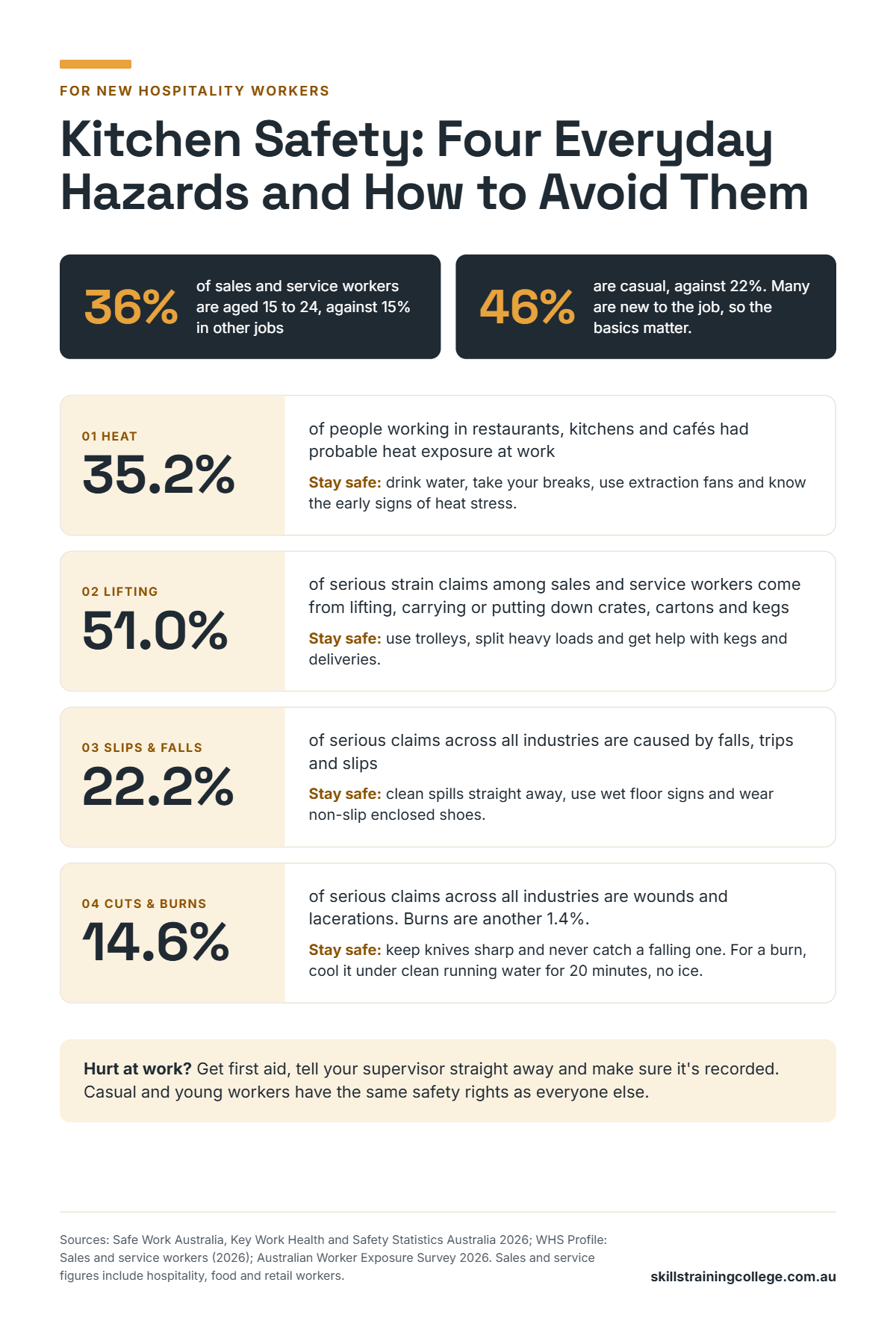
- 36% are aged 15 to 24, against 15% for all other occupations
- 46% are casual, against 22%
- accommodation and food services has the highest rate of job movement of any industry
With so many people starting new jobs, a good induction and knowing the basics yourself matter a lot.
The Main Kitchen Hazards, and How to Avoid Them
Heat
In the Australian Worker Exposure Survey 2026, 35.2% of people working in restaurants, kitchens and cafés had probable exposure to heat at work, and 33.0% across accommodation and food services.
How to avoid it: drink water regularly, take your breaks, use extraction fans, and know the early signs of heat stress such as heavy sweating, headache, dizziness and nausea. Read more about heatstroke symptoms.
Lifting and Carrying
Body stressing is the leading cause of serious claims for sales and service workers, at 40.8% of claims against 36.5% across all occupations. More than half of those (51.0%) come from lifting, carrying or putting down objects, most commonly crates, cartons, boxes, drums, kegs and barrels.
How to avoid it: use trolleys, split heavy loads, store heavy items between knee and shoulder height, and get help with kegs and bulk deliveries. A manual handling course teaches the techniques.
Cuts and Burns
Across all industries, wounds and lacerations make up 14.6% of serious claims and burns 1.4%.
How to avoid it: keep knives sharp and cut away from your body, use the right board, and never try to catch a falling knife. Use oven mitts, turn pan handles inward and call out “hot” and “behind” in a busy kitchen.
If a burn happens: cool it under clean running water for 20 minutes, don’t use ice, and get medical help for large or serious burns. Provide First Aid training covers burns, cuts and more.
Slips, Trips and Falls
Falls, trips and slips cause 22.2% of serious claims across all industries.
How to avoid it: clean spills straight away, use wet floor signs, wear non-slip enclosed shoes and keep walkways clear.
Repetitive Tasks
Wiping, stacking and repeated hand movements add up over a shift. Read our guide to repetitive strain injury for baristas.
Speak Up and Report Injuries
Safe Work Australia’s sales and service profile found that accommodation and food services has a lower share of injuries turning into serious claims than other priority industries, which suggests some injuries go unreported. Reporting early gets you first aid and support sooner and helps fix the hazard for everyone. Under work health and safety laws, workers can raise safety concerns without being punished for it.
Rules Every New Hospitality Worker Should Know
- Food handler training (Standard 3.2.2A): food businesses that handle high-risk, ready-to-eat food must make sure food handlers have completed food safety training, or have the right skills and knowledge, before handling that food. The business must also appoint a certified food safety supervisor, certified within the past five years, who is reasonably available to supervise.
- Responsible service of alcohol (RSA): if you serve alcohol, state and territory liquor laws require an RSA certificate. See our RSA course.
- Your safety rights: your employer must give you information, training, instruction and supervision to work safely. You must take reasonable care and follow reasonable safety instructions.
Training That Sets You Up
Frequently Asked Questions
What Are the Most Common Kitchen Injuries?
Strains from lifting and carrying, cuts, burns, and slips, trips and falls. Across hospitality and retail, lifting and carrying causes about half of serious strain injuries, mostly from crates, cartons and kegs.
What Are the Basic Kitchen Safety Rules?
Clean spills immediately, wear non-slip enclosed shoes, handle knives carefully, call out “hot” and “behind”, use trolleys for heavy loads, take water breaks in the heat, and know where the first aid kit is.
Do I Need Food Safety Training to Work in a Kitchen?
If the business handles high-risk, ready-to-eat food, Standard 3.2.2A requires food handlers to have completed food safety training or have the right skills and knowledge before handling that food. Check with your employer or local council.
How Do You Treat a Burn in the Kitchen?
Cool the burn under clean running water for 20 minutes, don’t use ice, cover it loosely with a clean dressing and get medical help for large, deep or serious burns. First aid training covers this in detail.
What Should I Do if I'm Injured at Work?
Get first aid, tell your supervisor straight away and make sure the injury is recorded. Reporting early gets you support and helps prevent the same injury happening to someone else.
Do Casual and Young Workers Have the Same Safety Rights?
Yes. Work health and safety laws protect all workers, whether casual, part-time or full-time, and whatever their age. Your employer must provide training and supervision.
Sources
- Safe Work Australia, Key Work Health and Safety Statistics Australia 2026, released 12 October 2026. https://data.safeworkaustralia.gov.au/reports/key-whs-statistics-australia/latest-release
- Safe Work Australia, WHS Profile: Sales and service workers (August 2026). https://data.safeworkaustralia.gov.au/insights/profile/whs-profile-sales-service-workers
- Safe Work Australia, 2026 Australian Worker Exposure Survey: Analytical Report (September 2026). https://data.safeworkaustralia.gov.au/datasets/australian-worker-exposure-survey
- Food Standards Australia New Zealand, Standard 3.2.2A – Food safety management tools. https://www.foodstandards.gov.au/business/food-safety/overview-food-safety-management-tools
- Safe Work Australia, Model Code of Practice: First aid in the workplace (July 2019). https://www.safeworkaustralia.gov.au/doc/model-code-practice-first-aid-workplace