
Construction Site Safety in Australia: The Fall, the Dust and the Heat

Table of Contents
Key Takeaways
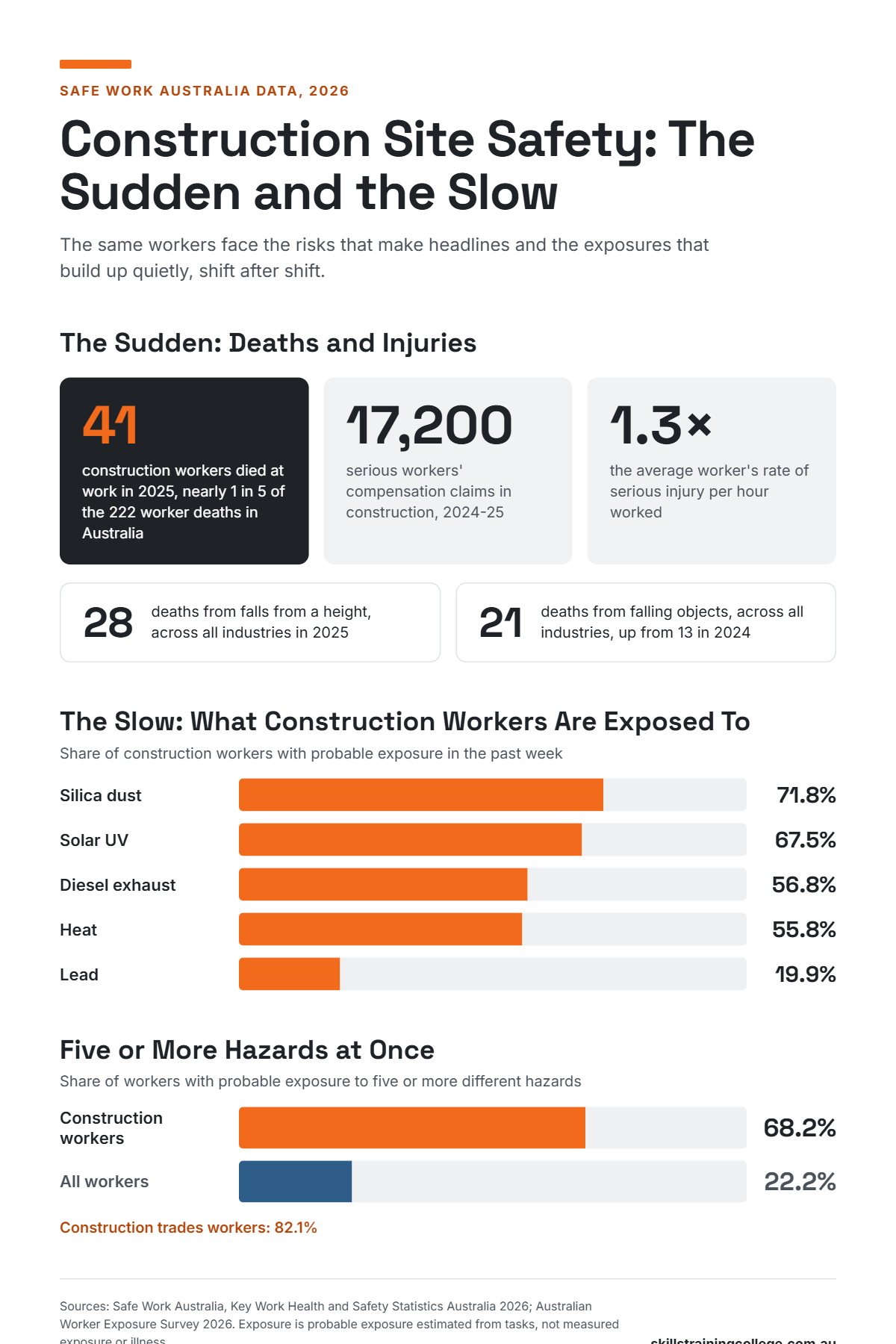
- In 2025, 41 construction workers died at work, nearly 1 in 5 of all worker deaths in Australia (Safe Work Australia, Key WHS Statistics 2026).
- A separate 2026 survey found 68.2% of construction workers probably have five or more hazard exposures at work, against 22.2% of all workers.
- So the risk on site is two-sided: the sudden event (a fall, a strike) and the slow one (dust, heat, sun). Planning for only one leaves the other uncovered.
When people think about construction site safety, they picture a single moment: a fall, a dropped tool, a vehicle. The 2026 Safe Work Australia data says that picture is half right. The sudden injuries are real and still happening. But the same workers are also breathing, sweating and squinting their way through hazards that don’t show up on an incident report.
How Many Construction Workers Die at Work in Australia?
Forty-one construction workers died from traumatic injuries in 2025, according to Safe Work Australia’s Key Work Health and Safety Statistics Australia 2026 (released 12 October 2026). That is almost one in five of the 222 worker deaths nationally, the highest national total since 2012. Construction recorded 35 in 2024 and 46 in 2023.
The report points to a pattern worth knowing. Falls from a height (28 deaths) and being hit by falling objects (21 deaths) were the second and third most common causes of death across all industries, and the report notes both are commonly associated with construction work. Falling-object deaths rose from 13 in 2024 to 21 in 2025. The report says construction activity has stayed high while labour shortages continue across many trades, and that these conditions have coincided with an increase in deaths from falls from height and falling objects.
In plain terms: a busy industry short of people is also one where falls and falling objects keep killing workers.
How Common Are Serious Construction Injuries and Claims?
Construction recorded 17,200 serious workers’ compensation claims in 2024-25 (a serious claim means a week or more off work). That is 11.7% of all serious claims in the country. The claim frequency is 8.8 per million hours worked, against 6.7 for all industries, so a construction worker is about 1.3 times as likely to be seriously injured per hour worked as the average Australian worker. The median claim involved 8.8 weeks off and a payout of $21,500 (figures for time lost and payout are from the 2023-24 year, because the latest year’s claims are still open).
Silica Dust, Heat and Sun: The Hazards on a Construction Site You Can't See
This is where the second report comes in. Safe Work Australia’s Australian Worker Exposure Survey 2026 asked 6,617 workers about the tasks they do and how they do them, then estimated each person’s probable exposure to a list of hazards in the previous week.
What the Survey Found for Construction Workers
For construction workers it found:
- Silica dust: 71.8% probably exposed
- Solar UV: 67.5%
- Diesel exhaust: 56.8%
- Heat at work: 55.8% (63.1% of people working on a construction site)
- Lead: 19.9%, about one in five
Across all these hazards, 68.2% of construction workers probably had five or more different exposures. For all workers that figure is 22.2%. Construction trades workers were higher again, at 82.1%.
Apprentices Carry the Most Exposure
Apprentices stand out. Across all industries, apprentices and trainees reported heat exposure at 51.1%, silica at 35.7% and lead at 17.0%. They were also more likely than other workers to report traumatic situations at work often or all the time (22.0% against 13.2%).
How to Read These Figures
A fair caution on these numbers. The survey estimates probable exposure from the tasks people describe. It does not measure what actually reached anyone’s lungs, and it does not count illness. Solar UV may also read high because the survey ran from December 2025 to February 2026, which is summer. “Exposed” does not mean “harmed”.
Why Falls and Exposures Need One Safety Plan
The deaths and claims data tells you what has already gone wrong. The exposure survey tells you what a typical site is asking workers to put up with right now. Put them side by side and a site worker’s day looks like this: working at height or under overhead work, in the sun, in heat, around dust and diesel.
That matters for first aid. A fall is an emergency you respond to. Heat illness is one you can spot early, if people on site know what it looks like. The survey measures heat exposure, not heat illness, so we can’t say how many cases occur. What we can say is that more than half of construction workers are working in it.
Construction Site Safety: What This Means for Workers
- You are probably carrying more than one hazard at a time. Ask what controls are in place for dust, heat and falls, not just the one that is most obvious.
- Know who the first aider is on your shift, where the kit is, and how an ambulance would get to where you are working.
- If you are an apprentice, say so when something doesn’t feel right. The data shows you are among the most exposed people on site.
Construction Site Safety: What This Means for PCBUs and Employers
- Under the model WHS laws, a PCBU must make first aid arrangements that suit the workplace, including equipment, trained first aiders and access to facilities. Check your own state or territory regulator for the exact rules, because Victoria’s laws differ from the model.
- Plan for the sudden event and the slow one in the same document. A site plan that covers falls but says nothing about heat or dust leaves half the picture blank.
- Don’t rely on one trained person. Crews work across shifts and areas of a site; first aid cover that depends on one person being present is fragile.
- Look at your apprentices’ tasks first. They carry the most exposure and the least experience.
- First aid is the last line of defence, not the first. Controls that remove or reduce the hazard come before training and kits. Both are needed.
Skills Training College delivers the HLTAID011 Provide First Aid course for construction crews and site supervisors, with onsite group training for whole teams. Getting new starters site-ready? The construction course bundle combines first aid, manual handling and the White Card.
Frequently Asked Questions
How Many Construction Workers Die at Work in Australia Each Year?
Forty-one construction workers died from traumatic injuries at work in 2025, according to Safe Work Australia’s Key WHS Statistics 2026. That is almost 1 in 5 of the 222 worker deaths nationally. The industry recorded 35 deaths in 2024 and 46 in 2023, so the count moves from year to year.
What Are the Main Causes of Construction Site Deaths?
The 2026 report breaks causes down nationally, not by industry. Across all industries the top three were vehicle incidents (41% of deaths), falls from a height (13%) and being hit by falling objects (9%). Safe Work Australia notes the last two are commonly associated with construction work.
What Is Silica Dust Exposure, and How Common Is It on Construction Sites?
Respirable crystalline silica is a fine dust released when materials such as concrete, brick and stone are cut, ground or drilled. In the 2026 Australian Worker Exposure Survey, 71.8% of construction workers had probable exposure in the week before the survey. Probable exposure is estimated from tasks. It is not a measure of illness.
What Are the Signs of Heat Stress at Work?
Early signs include heavy sweating, headache, dizziness, nausea, muscle cramps and unusual tiredness. Confusion, fainting or collapse can signal heat stroke, which is a medical emergency: call 000. In the survey, 55.8% of construction workers had probable heat exposure. An accredited first aid course teaches how to respond.
Does a Construction Site Need a First Aider?
Every workplace needs first aid arrangements, and the right number of first aiders depends on the risk, the number of workers and how far the site is from medical help. The model Code of Practice: First aid in the workplace explains how to work this out. Check your state or territory regulator for local rules.
Sources
- Safe Work Australia, Key Work Health and Safety Statistics Australia 2026, released 12 October 2026. https://data.safeworkaustralia.gov.au/reports/key-whs-statistics-australia/latest-release
- Safe Work Australia, 2026 Australian Worker Exposure Survey: Analytical Report (September 2026) and Insights from the Australian Worker Exposure Survey 2026 (16 September 2026). https://data.safeworkaustralia.gov.au/reports/hazards-and-injuries/insights-australian-worker-exposure-survey-2026